


From Aircraft Engine to Design: Skypak INTAKE
What happens when a piece of aircraft engineering leaves the engine and enters the world of contemporary interiors?
The answer is Skypak INTAKE — an extraordinary conference and dining table built around an original aircraft component.
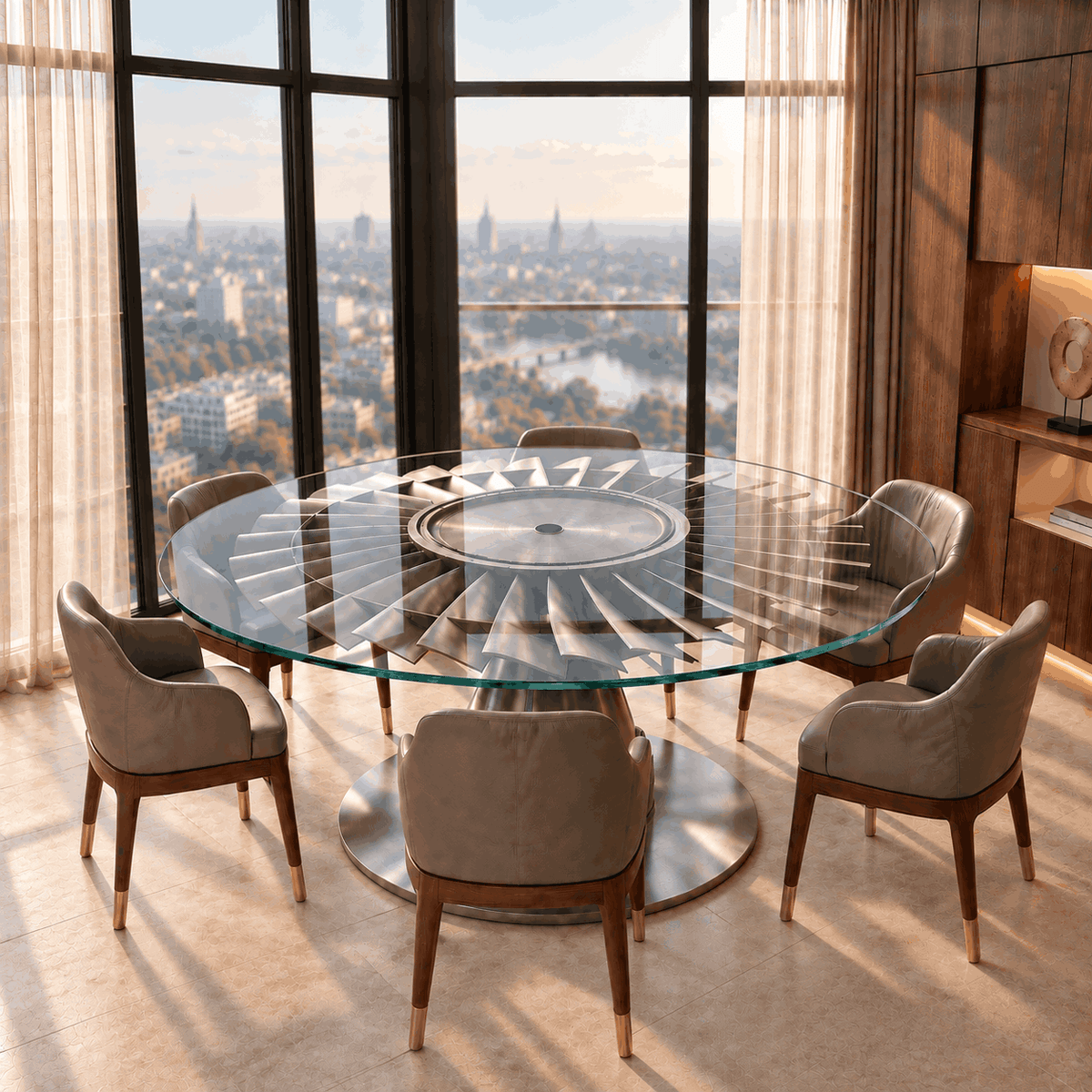
At its centre is an original N1 fan from an Ilyushin IL-76 aircraft engine — a component whose form was shaped by engineering, airflow and precision rather than aesthetics. Today, its striking radial structure sits beneath a transparent glass tabletop, fully visible from every angle.
Nothing about the fan was originally intended to be decorative. And that is precisely what makes it so fascinating.

From the IL-76 to Contemporary Interiors
Classic versions of the Ilyushin IL-76 heavy transport aircraft were powered by four D-30KP turbofan engines. Inside this complex engineering system, the first-stage rotor of the low-pressure compressor formed part of the N1 rotor system.
Seen in its original environment, the fan immediately reveals where its distinctive geometry comes from. Arranged around the central axis of the engine, its blades were designed as part of a highly functional system in which airflow, precision and engineering determined every detail.

For anyone unfamiliar with aircraft engineering, this view provides the missing context: the radial structure that defines the INTAKE was originally part of the internal architecture of an aircraft engine.
The blades, their angles and their radial arrangement were developed as part of a functioning aircraft engine. Yet removed from that environment, the same structure reveals an unexpected visual quality.
The repetition of the blades creates rhythm. Their curved metal surfaces catch the light. Viewed from different angles, the component seems to change constantly — sometimes mechanical and precise, sometimes almost sculptural.
The engineering has not changed. Only the perspective has.
When an Aircraft Component Becomes the Centrepiece
INTAKE does not imitate aviation design. It brings an authentic aviation component directly into the interior.
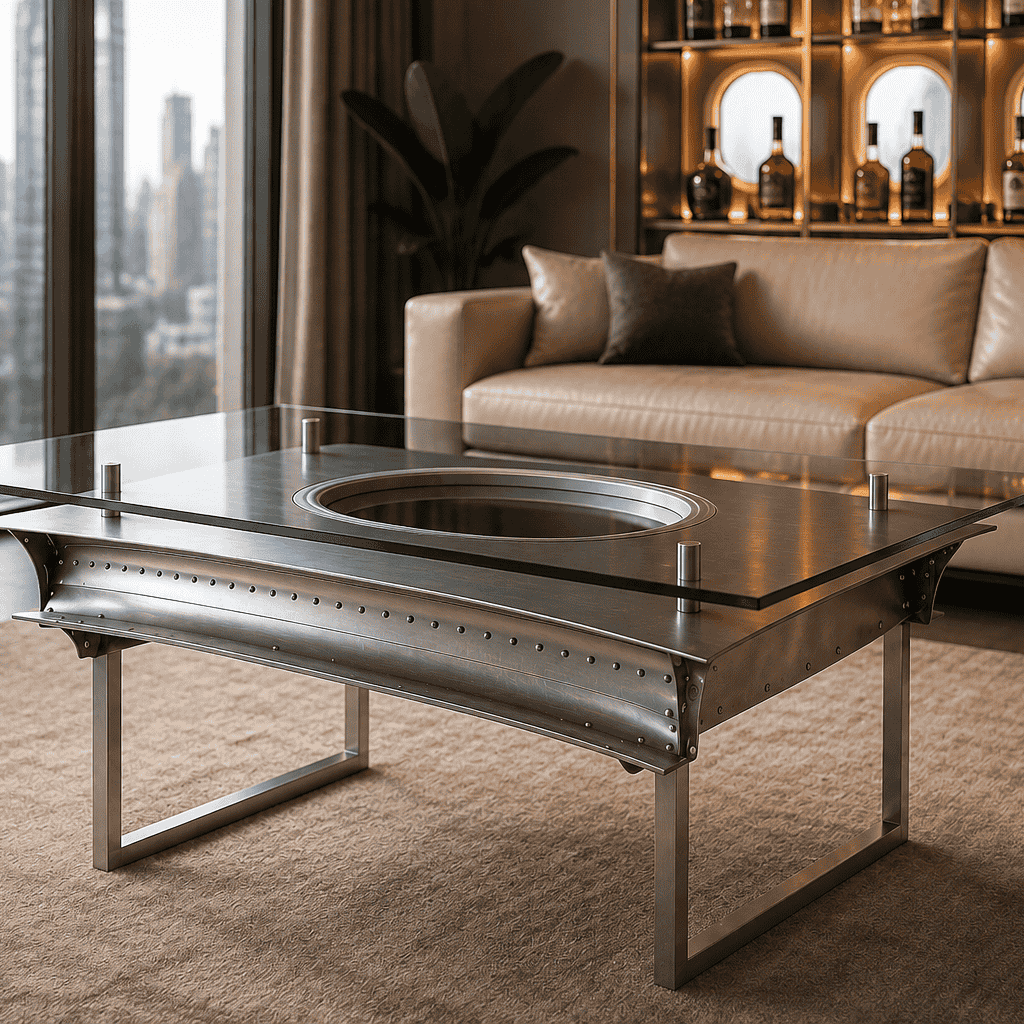
Instead of hiding the N1 fan inside a conventional table construction, Skypak makes it the focal point. A circular glass tabletop opens the view onto the complete radial structure beneath. The restrained metal base remains visually secondary, allowing the fan itself to define the character of the piece.
Transparent glass meets industrial metal, contemporary furniture design meets a component built for an entirely different world — and the result is a conference and dining table whose story doesn't need to be added afterwards. It's already built into the object.
A Design That Changes with Your Perspective
Walk around INTAKE and the experience changes.
At eye level, reflections on the glass interact with the metallic surfaces underneath. Individual blades overlap, disappear and reappear as the viewing angle shifts.
Look from above and an entirely different composition emerges.

The central disc and surrounding blades create a precise circular pattern that makes the original engineering structure particularly striking. What once formed part of the internal architecture of an aircraft engine now becomes something designed to be observed. The transparent tabletop doesn't cover that history — it gives it space.
Aviation Heritage Without an Aviation-Themed Interior
An object with such a strong aviation background might suggest an equally aviation-inspired environment.
INTAKE proves the opposite.
Warm wood, natural stone, glass, soft textiles and restrained architecture create a compelling contrast with the technical character of the fan. In a contemporary residence, penthouse, executive boardroom or exclusive hospitality setting, INTAKE needs no aircraft photographs, models or other aviation references around it — the original component tells that story on its own.
Because the surrounding interior can remain quiet, attention naturally returns to the table: first to its unusual silhouette, then to the blades beneath the glass, and finally to the question behind the object. Where did this come from?
That moment of discovery is part of what makes INTAKE more than an ordinary table.
From Engineering to Conversation
There is something fitting about the transformation. A component once hidden inside an aircraft engine becomes the centre of a place where people meet. Something created for movement becomes a place to pause. Technical precision becomes visual character.
The aircraft component does not lose its identity — it simply begins a new chapter.
Discover INTAKE
Authentic aviation history, reimagined for contemporary interiors.
Explore Skypak INTAKE and discover how an original aircraft engine fan becomes an extraordinary table for dining and meetings.