





Airport Codes: Why Three Letters Inspire a World of Travel
FRA. JFK. LHR. DXB. SYD.
To some, they are simply combinations of three letters printed on baggage labels and departure boards. To travellers, aviation enthusiasts and globetrotters, however, airport codes mean much more. They represent cities, journeys and moments that remain with us long after a flight has landed.
A familiar airport code can awaken the memory of an unforgettable holiday, a long-awaited reunion or the beginning of a new chapter. It may recall the excitement of arriving somewhere for the first time—or the reassuring feeling of returning home.
This emotional language of travel lies at the heart of the Skypak Airline Trolley – Airport Codes Edition. Inspired by the international network of airports that connects our world, the design transforms functional aviation terminology into a distinctive statement for modern interiors.
But why do these three-letter codes fascinate people around the globe?
Three Letters, One Destination
Airport codes are designed to make a complex international aviation system easier to navigate. The three-letter identifiers commonly seen by passengers are assigned and maintained by the International Air Transport Association, better known as IATA.
These codes allow airlines, airports and travel systems to identify locations quickly and precisely. They appear throughout the passenger journey: on tickets, itineraries, departure boards, baggage tags and reservation systems.
The principle is remarkably simple. Instead of repeatedly writing “Frankfurt Airport,” the aviation industry uses FRA. London Heathrow becomes LHR, New York’s John F. Kennedy International Airport becomes JFK, and Dubai International Airport becomes DXB.
According to the International Air Transport Association, these universal location identifiers support communication across reservations, scheduling, ticketing, baggage handling, cargo operations and other travel systems. They create a concise international language that can be understood regardless of a traveller’s native language.
Yet their appeal extends far beyond logistics. Through their constant presence on tickets and baggage labels, airport codes have become visual symbols of movement, discovery and international life.
Airport Codes as a Universal Language
Most languages require translation. Airport codes do not.
A passenger in Berlin, Tokyo, Cape Town or São Paulo can recognise the same three letters on a departure board. The typography may change and the announcement may be made in another language, but the destination code remains the same.
This makes airport codes one of the most recognisable visual languages in the world. Their simplicity gives them extraordinary power: three letters can stand for an entire city, region or travel experience.
Consider the impressions created by just a few well-known codes:
- JFK evokes New York, yellow taxis, towering architecture and the energy of Manhattan.
- CDG suggests Paris, French culture, elegant boulevards and creative heritage.
- DXB calls to mind Dubai’s futuristic skyline and position as a global crossroads.
- HND represents Tokyo and the fascinating contrast between technological precision and tradition.
- SYD evokes Australia, its famous harbour and the beginning of journeys across the Pacific.
- CPT conjures images of Cape Town, Table Mountain and the meeting point of city, ocean and landscape.
Every code is compact, but the associations behind it are almost limitless.
Why Airport Codes Become Personal
The fascination with airport codes is not only about geography. It is about biography.
Over time, certain codes become part of a person’s own story. The airport closest to home may represent familiarity and belonging. Another might recall a first journey abroad. A third may be connected to a relationship, a career opportunity or an adventure that changed one’s view of the world.
The Code That Means Home
For frequent travellers, the code of their home airport carries a special significance. Spotting it on a departure board in another country can create an immediate feeling of recognition.
After days or weeks away, those three letters no longer describe only an airport. They mean familiar streets, people and routines. They mean home.
The Code of a Memorable Journey
Other codes become meaningful because of what happened after arrival. They may be associated with a honeymoon, a spontaneous weekend, a family holiday or a business trip that opened new possibilities.
The emotional value does not come from the airport building itself. It comes from the experiences attached to the destination.
The Code of Somewhere Still to Discover
Airport codes can also represent journeys that have not yet happened. A destination saved in a travel app or written at the top of a wish list carries the promise of future discovery.
In this way, airport codes connect memory and imagination. Some remind us where we have been; others encourage us to think about where we might go next.
A System Filled With Stories
Many airport codes appear immediately logical. Amsterdam is AMS, Madrid is MAD, and Singapore is SIN. Others reveal parts of a city’s history or the former name of an airport.
New York’s JFK, for example, commemorates President John F. Kennedy. Chicago O’Hare uses ORD, a code inherited from the site’s earlier name, Orchard Field. Such examples make airport codes small pieces of cultural and aviation history.
Then there are codes that seem mysterious at first glance. They encourage travellers to ask questions, search for their origins and exchange stories about unusual destinations.
That combination of order and mystery is part of their enduring appeal. The system is technical, but the individual codes often contain layers of history, geography and identity.
From Baggage Tag to Design Icon
Airport codes have developed a visual identity of their own. Their clean lettering, compact format and international character are closely associated with departure boards, baggage tags and the graphic world of commercial aviation.
Outside the airport, this visual language has found its way into fashion, art and interior design. Airport codes work particularly well as design elements because they are minimal without feeling anonymous. They communicate something personal while retaining a precise, modern aesthetic.
A code can be understood as typography, but it can also act as a memory. Placed in an interior, it becomes a quiet reference to movement, freedom and the wider world.
This is precisely what gives the Skypak Airport Codes Airline Trolley its distinctive character.
The Skypak Airline Trolley – Airport Codes Edition
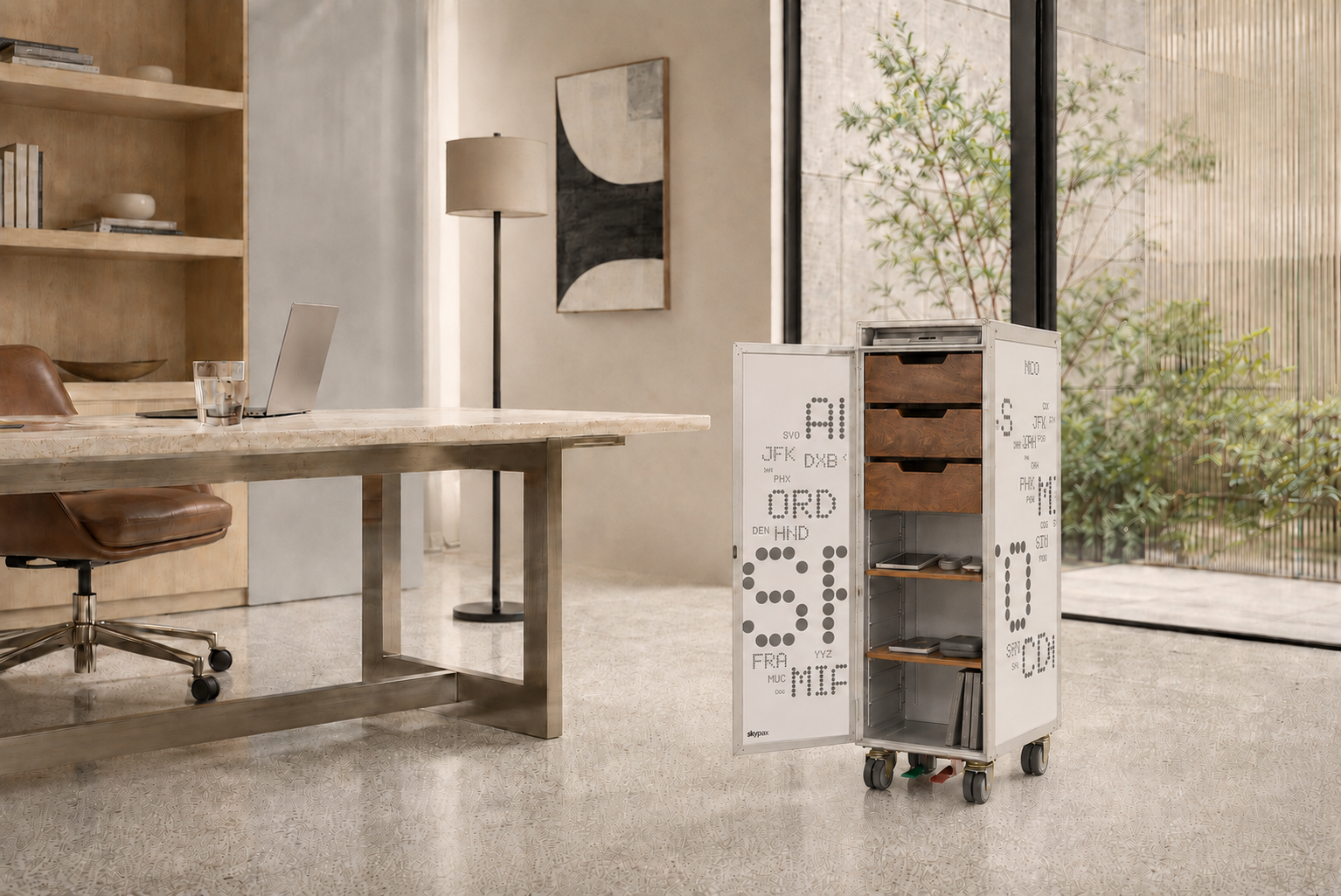
The Airport Codes Edition brings the visual language of international aviation into the home, office, hotel or lounge. Its graphic surface is covered with codes that immediately invite recognition:
Which airports have you visited? Which destinations are still on your list? Which three letters mean the most to you?
The design turns an everyday object from the world of aviation into a conversation piece. Even before the trolley is opened or used, it encourages people to share travel memories and compare destinations.
At the same time, its authentic airline proportions give it a presence that ordinary storage furniture cannot reproduce. The narrow body, precision fittings, smooth-running wheels and robust materials express the functional character of aviation equipment.
The result is a piece that combines graphic design, engineering and emotion.
Designed for More Than Display
The Airport Codes Edition is not merely an aviation-inspired decorative object. It is a fully functional piece of furniture designed for flexible use in real interiors.
Made from aluminium and stainless steel, the trolley combines durability with a compact footprint. At approximately 103 centimetres high, 30 centimetres wide and 40 centimetres deep, it can be integrated into spaces where a conventional cabinet or bar might be too large.
Its interior can be configured with different shelves, drawers and accessories, allowing the trolley to take on a variety of roles.
A Mobile Bar for the Home
Equipped with bottles, glasses and bar accessories, the trolley becomes a sophisticated mobile drinks station. Its airport code design is especially fitting when serving international wines, spirits or cocktails inspired by destinations around the world.
In a loft, dining area or penthouse, it introduces an industrial accent without sacrificing elegance.
A Minibar for Hotels and Guest Suites
In hospitality interiors, the trolley creates a direct connection with the idea of travel. It can function as a distinctive minibar in a hotel room, suite or private lounge while contributing to the overall interior concept.
Unlike a conventional minibar cabinet, it gives guests something to notice, explore and remember.
A Coffee Station for the Office
In an office, conference room or reception area, the Airline Trolley can be configured as a compact coffee station. Its mobility allows it to be moved wherever it is needed, while the airport code design reflects international ambition and connectivity.
It is particularly suited to businesses operating across borders or companies with a close relationship to aviation, tourism, logistics and design.
Flexible Storage With Character
Shelves and drawers can transform the trolley into storage for documents, accessories, tableware or personal collections. Its slim form makes efficient use of space, while its visual presence turns practical storage into a deliberate design decision.
Aviation Design for International Interiors
The Airport Codes Edition feels at home in a wide range of environments because it brings together two seemingly different qualities.
On one hand, it is technical and precise. Its materials, fittings and proportions reflect the disciplined engineering of aviation. On the other, it is highly emotional. The codes on its surface invite stories of distant places and personal journeys.
This balance allows the trolley to complement several interior styles:
- In minimalist spaces, it becomes a graphic focal point.
- In industrial interiors, its metal construction enhances the architectural character.
- In luxurious settings, it introduces an unexpected piece of authentic aviation culture.
- In creative offices, it communicates curiosity and an international outlook.
- In private homes, it becomes a personal collection of destinations and memories.
Wherever it is placed, the trolley offers more than function. It gives the surrounding space a story.
A Conversation That Begins With Three Letters
Good design often creates interaction. It makes people pause, look more closely and ask questions.
The Airport Codes Edition achieves this naturally. Guests may recognise the airport they travelled through last summer. A colleague may point out the code of their hometown. Someone else may discover the abbreviation of a destination they have always wanted to visit.
In a matter of seconds, three letters can begin a conversation about countries, cultures and experiences.
That quality makes the trolley especially valuable in social spaces. In a hotel lounge, executive office or private living area, it acts as a point of connection. It encourages people to exchange stories—and almost everyone has an airport story to tell.
A Symbol of Wanderlust
Wanderlust is difficult to express through an ordinary object. It is a feeling composed of curiosity, anticipation and the desire to encounter something unfamiliar.
Airport codes capture that feeling with remarkable efficiency. They appear at the moment when an idea of travel becomes real: when a ticket is issued, a bag is checked or a destination appears on the departure board.
For this reason, the codes remain emotionally charged even when removed from the airport environment. They retain the promise of movement.
The Skypak Airport Codes Airline Trolley brings that promise into everyday life. It does not simply depict an aircraft or reproduce a nostalgic travel image. Instead, it uses the genuine visual vocabulary of global aviation.
The design feels modern because the code system is timeless. It belongs to the history of commercial flight, but it continues to guide millions of journeys today.
Which Airport Code Tells Your Story?
Perhaps it is the code of the city where you were born. Perhaps it represents the place where you met someone important, achieved a personal goal or discovered a new culture.
It might belong to an airport you pass through every month—or to a destination you have never visited but continue to dream about.
This is what makes airport codes so fascinating: their official meaning is universal, but their emotional meaning is personal.
They organise the global movement of people and baggage while also becoming markers in our individual memories. They are functional identifiers transformed by experience into symbols of home, adventure and possibility.
The Skypak Airline Trolley – Airport Codes Edition celebrates both sides of this language. It combines the precision of aviation with the stories that make travel meaningful.
Three letters may identify a destination. But for the person reading them, they can contain an entire world.