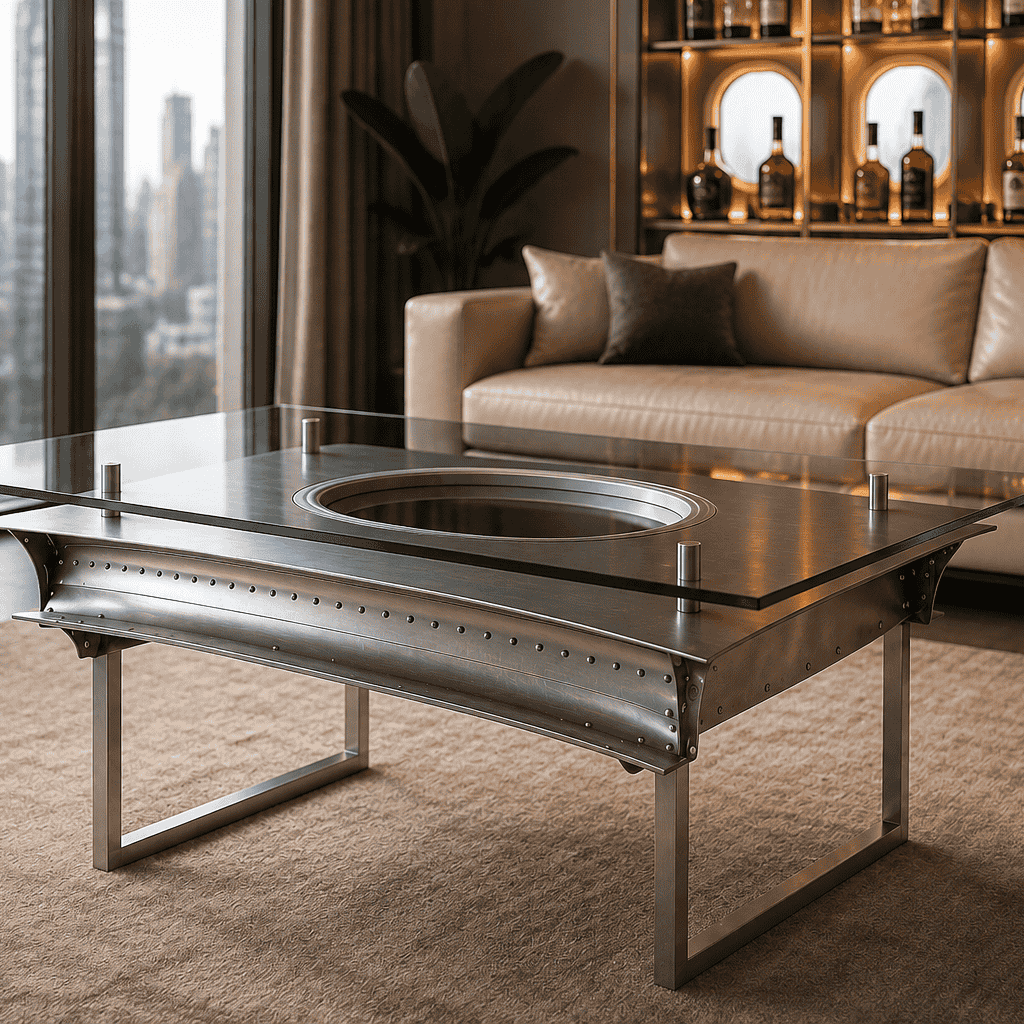



A Real Aircraft Window as a Wall Bar
There are objects that enter a room quietly, and there are objects that bring another world with them. An original aircraft window belongs to the second kind.
Its rounded geometry is immediately familiar. Even outside an aircraft cabin, it recalls departure boards, distant cities, the changing light above the clouds and the moment when the ground falls away beneath a wing.
For most of its working life, an aircraft window segment is part of a much larger structure. It is designed for precision, efficiency and endurance rather than for display. Only when it leaves the aircraft does its visual identity become fully apparent: the curved aluminium skin, the repeated pattern of rivets, the compact oval opening and the subtle traces left by years of service.
What once framed a view of the sky can then frame something entirely different.
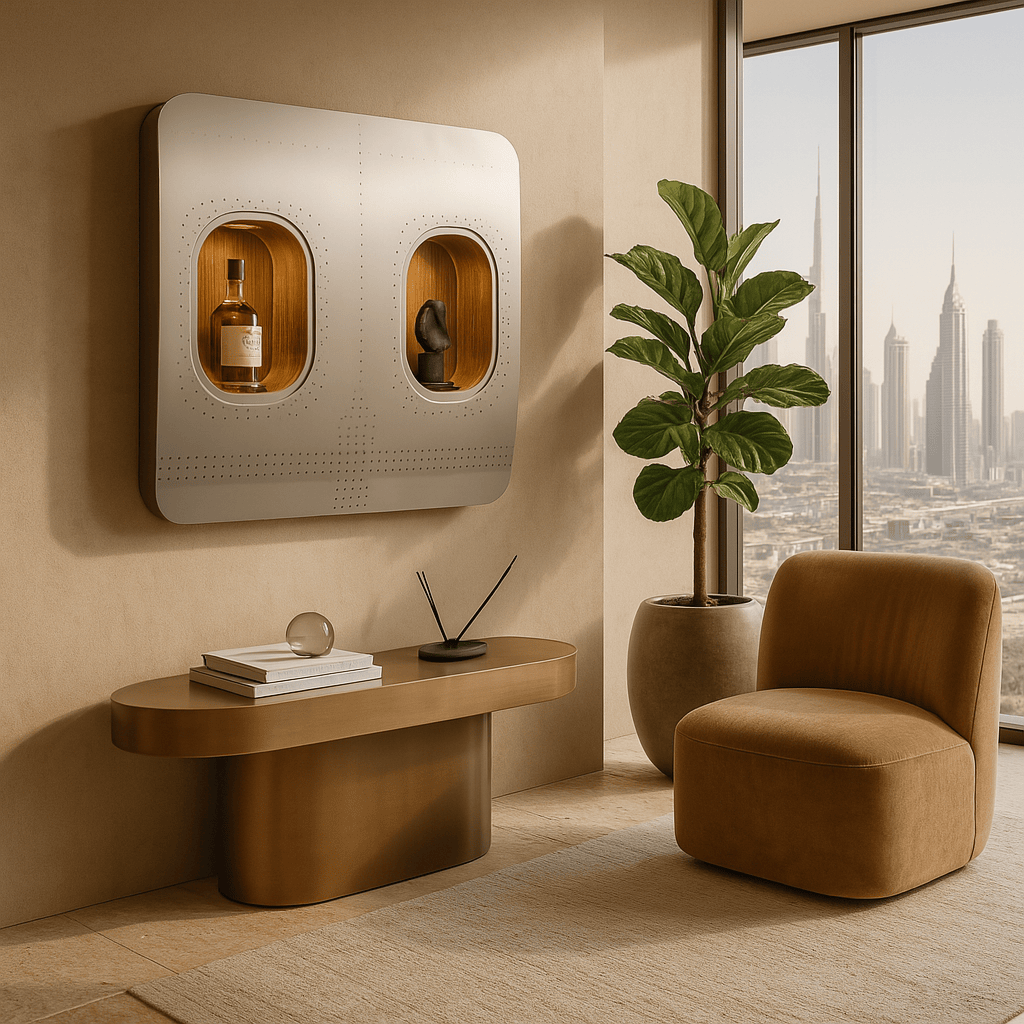
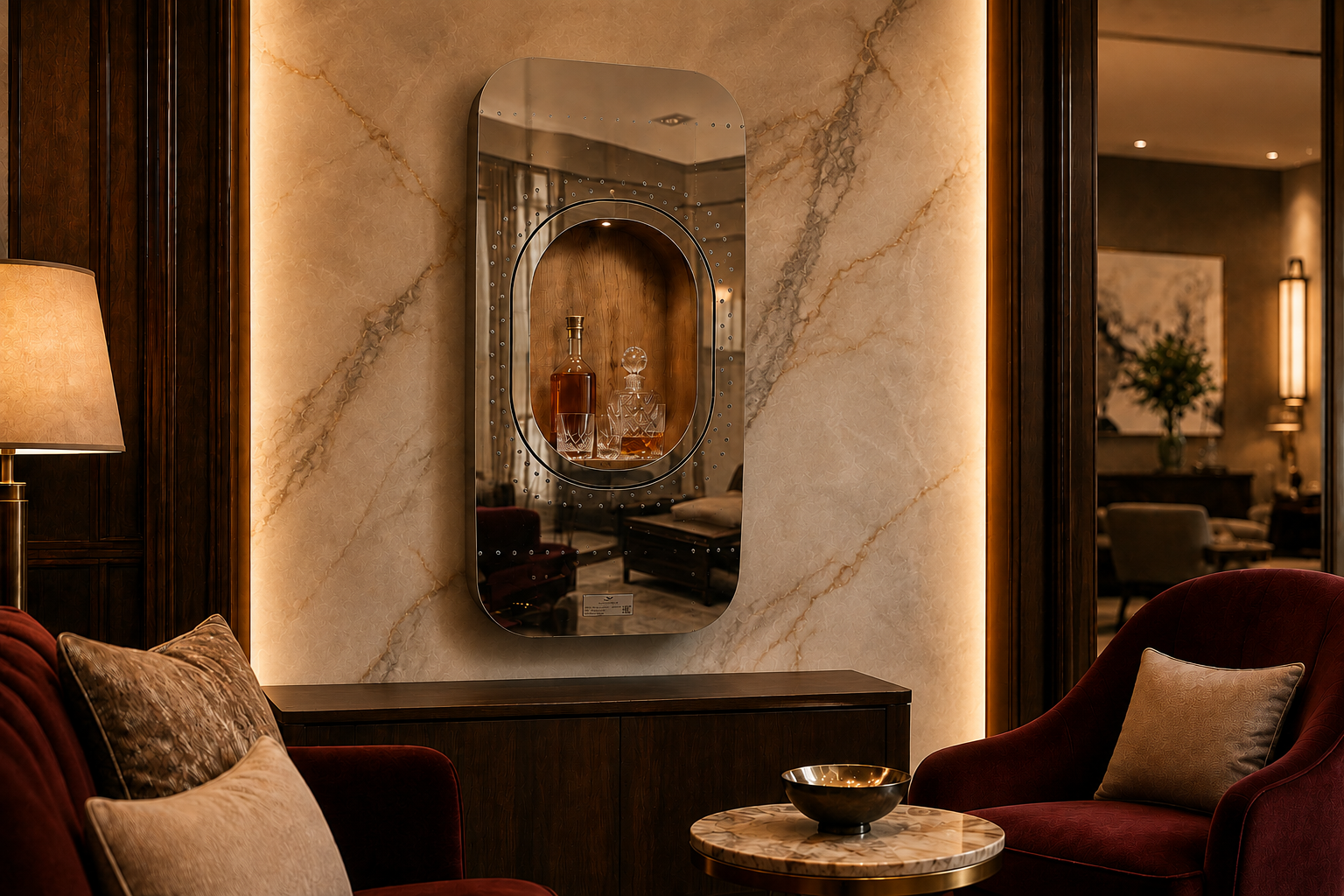
At Skypak, this transition becomes the beginning of a new story. An original aircraft window segment is carefully transformed into a wall-mounted bar and display object. The result is not an imitation of aviation design. It is a surviving part of aviation itself, given a new purpose through craftsmanship.
The Window That Once Framed the Sky
An aircraft window is an unusually powerful object because it is both technical and emotional.
Its form is the result of engineering, yet it has become one of the most recognisable symbols of travel. For decades, passengers have looked through windows like these to watch coastlines disappear, mountain ranges unfold and cities turn into patterns of light.
Once removed from the fuselage, the window carries that memory without needing to explain it. The material is enough. Aluminium, contours and rivets reveal where it came from. The object may no longer be travelling, but it still suggests movement.
This tension between a fixed place on the wall and a history shaped by distance gives the Aircraft Window Wall Bar its particular presence.
It also explains why the piece works as more than decoration. It invites recognition, followed by curiosity. Guests tend to notice the familiar outline before understanding what they are looking at. The conversation often begins with a simple question:
Is that a real aircraft window?
From there, the object tells its own story.
From Fuselage Segment to Wall Bar
Transforming an original aircraft component into an interior object requires restraint. Too much intervention would erase the qualities that make the segment authentic. Too little would leave it without a convincing new function.
The craft lies in finding the balance between preservation and transformation.
The outer aircraft skin remains central. Depending on the chosen version, the aluminium can be finely brushed or polished to a high-gloss finish. Brushed surfaces emphasise the industrial calm of the material, while polished aluminium reflects the surrounding architecture and allows the wall bar to change subtly with the room.
Neither treatment hides the essential construction. The window form, metal edges and rivet patterns remain visible as evidence of the object’s first life.
Behind the opening, a precisely made display box creates the new interior. Fine wood introduces warmth to the technical aluminium, while high-gloss lacquer can give the composition a more graphic and architectural character.
Optional integrated LED lighting adds another layer, but its purpose is not to turn the piece into a spectacle. Used carefully, the light reveals the grain of the wood, the colour of a spirit and the cut of a glass.
The compact Aircraft Window ONE in high-gloss silver, for example, measures approximately 75 centimetres high, 45 centimetres wide and 12 centimetres deep. Its scale allows the original window to remain visually dominant while providing enough space for a small, considered arrangement.
Larger versions extend the idea across two, three or four window openings, creating a stronger architectural rhythm for generous walls and hospitality spaces. Together, the different formats form the wider Skypak Aircraft Windows collection, allowing the original aviation geometry to work at different architectural scales.
Why Authenticity Changes the Way We See an Object
A replica can reproduce a silhouette. It cannot reproduce a past.
This distinction matters in interiors increasingly filled with objects designed to appear aged, industrial or rare. Authentic material carries a different kind of depth because its history has not been applied as a decorative finish. It is already present.
Subtle variations are therefore not flaws to be corrected. Original aircraft segments can differ according to the available aircraft type, and individual details may vary. Small traces, rivet arrangements and the exact character of the metal make every Aircraft Window Wall Bar unique.
They are evidence of provenance rather than deviations from a perfectly repeated product.
This is also why the wall bar rewards close viewing. From across the room, its outline reads as a clear design statement. Up close, the construction tells a more intricate story.
The eye follows a line of rivets, catches a softened reflection in polished aluminium or discovers the contrast between cool metal and warm wood. The object offers both immediate visual impact and details that continue to reveal themselves over time.
A New View: What the Wall Bar Frames Today
A window is defined by what it frames.
In an aircraft, it frames the world outside. As a wall bar, it frames a smaller and more personal landscape: a bottle brought back from a journey, crystal glasses reserved for particular evenings, a vintage aviation object, a book or a sculptural piece collected over time.
The most convincing arrangements are rarely the fullest. One exceptional bottle can say more than a crowded display. A decanter and two glasses create the suggestion of a ritual without turning the wall into storage.
In this sense, the wall bar is closer to a curated niche than to a conventional cabinet. It gives selected objects space, light and context.
This restraint allows the aircraft component itself to remain the focus. The contents may change with the setting or season, but the story of the window stays constant. It is the frame that gives meaning to what is placed within it.
Where Aviation History Meets Interior Architecture
Because it is mounted on the wall, the Aircraft Window Wall Bar occupies an interesting position between furniture and architecture.
It does not require floor space, yet it has more physical presence than a picture or conventional mirror. Its shallow depth creates a floating effect, while its aluminium surface responds to nearby stone, timber, textiles and light.
In a Private Living Space
In a living room, library or penthouse lounge, a single aircraft window can create an intimate focal point.
Mounted above a low sideboard or placed within a carefully illuminated wall bay, it becomes part of the evening atmosphere. Warm woods, limestone, leather and velvet soften the technical origins of the aluminium without disguising them.
The contrast is precisely what makes the composition feel considered. The object does not need to match every other material in the room. Instead, it introduces a distinct layer of history and character.
In Hotels and Hospitality Interiors
A boutique hotel, private club or luxury suite can use the wall bar to connect function with narrative.
Hospitality design is often strongest when guests remember a particular detail rather than an entire theme. An authentic aircraft window provides that memorable detail without turning the room into an aviation set.
It can suggest travel, movement and cosmopolitan life while remaining elegant, compact and useful. In a hotel suite, it may serve as an unconventional minibar. In a lounge or private club, it can display selected spirits or objects associated with the identity of the space.
The connection to travel is present, but it remains subtle.
In Offices, Lounges and Reception Areas
In a company lounge or reception area, the wall bar can represent movement, engineering and transformation.
For businesses connected to travel, technology or design, these associations arise naturally. For others, the appeal may lie simply in the quality of the material and its unexpected change of context.
Either way, an authentic aircraft component gives the interior a point of identity that standard contract furniture rarely provides. It becomes a conversation piece without losing its function.
Reflection as Part of the Design
The high-gloss Aircraft Window Wall Bar has a quality that deserves particular attention: it does not merely sit within a room. It reflects the room back.
Stone, walnut, lamps and upholstered furniture appear in the curved aluminium as softened fragments. As daylight changes, the surface changes with it. In the evening, warm architectural lighting can deepen the metal and make the wooden niche appear almost like a small illuminated cabin.
This makes placement important.
A polished wall bar should reflect an intentional part of the interior rather than visual clutter. Architects and interior designers can treat the aluminium as a dynamic material, much like smoked glass or a softly distorted mirror.
The reflection becomes part of the composition, connecting the aircraft segment to its new surroundings. The wall bar can therefore appear different in a warm hotel lounge, a minimal penthouse or a darker private library, even though the object itself remains unchanged.
The matt brushed version behaves differently. It absorbs the room more quietly and emphasises the tactile grain of the metal.
The choice is therefore not simply between two finishes. It is a choice between two relationships with light: one reflective and changing, the other calm and architectural.
Upcycling Without Erasing the Past
Giving an aircraft component a second life is often described as upcycling, but the word alone does not capture what is valuable here.
The point is not merely that a material is reused. It is that its identity survives the transformation.
Aircraft aluminium was created for demanding conditions and long service. When a usable segment is removed from its original context, discarding its visual and cultural value would mean losing more than raw material.
Thoughtful reuse preserves embodied craftsmanship, engineering and history. It allows a component designed for mobility to continue its life in a more permanent setting.
At the same time, responsible design should avoid romanticising every trace without purpose. The new object must work. Edges need to be carefully finished, the internal box precisely made, the mounting considered and the presentation coherent.
Sustainability becomes meaningful when the second life is not temporary, but desirable enough to endure.
Made by Hand, Shaped by the Original
Skypak’s design philosophy begins with the original component rather than forcing every aircraft segment into an identical mould.
This is an important difference. The available aircraft part determines certain details, while the finishing, interior material and lighting allow the piece to be adapted to its destination.
Handcraft is not used to make the past disappear. It is used to reveal it with clarity.
Polishing brings depth to aluminium. Wood introduces warmth without competing with the aviation geometry. Carefully placed light focuses attention on the opening. Each decision supports the original form rather than replacing it.
For bespoke interiors, this dialogue can continue through material and colour choices.
A restrained oak interior may suit a private residence. Black piano lacquer can create a more dramatic gallery character. White lacquer can integrate the piece into a lighter architectural scheme.
The strongest solution is the one that allows the wall bar to belong to its new room while remaining unmistakably what it once was.
A Wall Bar That Does Not Need to Behave Like a Bar
Although its new function is reflected in its name, an Aircraft Window Wall Bar does not have to be used exclusively for bottles and glasses.
Its window opening can frame a sculpture, a piece of aviation memorabilia, a rare book or an object with personal meaning. In a hotel, it could present a locally selected spirit. In a company reception area, it might display an object connected to the organisation’s history.
This flexibility matters because the wall bar is not designed as conventional storage. It is a stage for a small number of carefully chosen objects.
Its purpose can therefore evolve without changing the aircraft component itself. What it frames may change, but the window remains the visual and historical centre of the composition.
Design with a History Is Design for the Future
The most enduring interiors are rarely built from newness alone. They bring together different times, materials and meanings.
An original aircraft window introduces a past that is specific, yet open enough for people to connect with it in their own way.
One person may remember a first flight. Another may think of a city seen at dawn. Someone else may simply admire the honesty of the engineering.
As a wall bar, the window gains a new ritual. It becomes part of arrivals rather than departures: an evening drink, a conversation with guests or a moment of pause at the end of the day.
Its function has changed, but the sense of possibility remains.
That is the deeper idea behind design with a history. It does not preserve an object by freezing it in time. It allows the object to continue.
The aircraft window no longer looks out onto the world, yet it still opens a view - into craftsmanship, memory and the many lives a material can hold.